For Rockwall homeowners and commercial property managers, indoor comfort is won or lost at the roof. A sun-baked roof can drive attic temperatures well past 130°F, push HVAC systems to their limits, and turn second floors into hot zones. Cool roof systems help break that cycle. By reflecting more sunlight and releasing stored heat, these roofs maintain a steadier building temperature and reduce energy strain, even during a North Texas heat wave.
This article explains how cool roofs improve day-to-day comfort in homes and commercial buildings across Rockwall, 75087 and 75032. It also covers what materials work, how they perform in the North Texas climate, and when a reflective coating or membrane makes sense. It closes with local details for commercial properties near Lake Ray Hubbard, since many of those buildings face extreme solar load along the I-30 corridor. The goal is simple: help local owners make a clear decision about energy efficient roofing.
Why indoor comfort starts at the roof
Roofs in North Texas take a harsher beating than most regions. Midday solar radiation hits hard, the ambient air is hot, and humidity slows heat release. A dark roof absorbs most of that energy. The heat migrates into attic air, ductwork, and ceiling cavities. The result is familiar: rooms feel stuffy by afternoon, AC runtimes jump, and air feels uneven across the home or office.
Cool roof systems interrupt that chain. They increase solar reflectance to bounce sunlight away and improve thermal emittance to shed heat that does get absorbed. With less heat entering the structure, the attic stays cooler, the HVAC cycles less often, and interior temperatures remain more stable. People feel the difference as a quieter AC, fewer hot spots, and a cooler second story during peak sun.
What counts as a cool roof in Rockwall
A cool roof is not just a white surface. It is a system with measurable solar reflectance and thermal emittance. Products rated by the Cool Roof Rating Council (CRRC) list both values. In practice, high-performing cool roof assemblies in Rockwall use one of three approaches: reflective shingles for steep-slope homes, a reflective membrane such as TPO or PVC for low-slope sections, or a fluid-applied coating over an existing roof to restore reflectivity and seal small gaps. Each option targets heat control first, then durability and watertight protection.
Many Rockwall homes have mixed-slope roofs. A steep front elevation may pair with a low-slope rear addition or patio cover. This is a good fit for blended solutions, like cool-color shingles facing the street and a bright TPO membrane over the flat area. The seamless approach protects against ponding and cuts radiant heat in spaces below.
How cool roofs change the feel of a house
Homeowners notice comfort in simple ways: how a bedroom feels at 4 p.m., how fast the thermostat recovers after cooking, or how often the AC kicks on at night. A reflective roof reduces peak heat gain, so upstairs rooms hold a set temperature longer. Ducts run cooler in the attic. Bedrooms and bonus rooms under the roofline feel more balanced, which matters in two-story homes in Breezy Hill, Stone Creek, and Northshore.
For single-level homes near Lake Ray Hubbard, radiant heat through the deck often drives interior temps in late afternoon. A reflective surface interrupts that load. The result is less temperature drift and fewer “baked” zones at the western side of the home.
On the commercial side, comfort shows up as steadier indoor temps across open floor plans. Retail spaces near The Harbor and office suites in Buffalo Creek often suffer from hot ceilings by midday. A high-reflectivity TPO or PVC surface keeps the plenum cooler and eases the burden on rooftop AC units (RTUs). Staff and customers feel the benefit as a stable, comfortable space with fewer complaints about hot aisles or uneven airflow.
The performance math: reflectance, emittance, and attic heat
Two metrics guide cool roof performance. Solar reflectance is the fraction of sunlight bounced back. Thermal emittance is the surface’s ability to release stored heat. A high-reflectance, high-emittance surface cuts the roof temperature, which lowers attic air temperature. In summer, a drop of 30 to 60°F at the roof surface can translate into a double-digit reduction in attic air temperature. That reduction matters because the attic is a buffer zone that leaks heat into the living area through conduction and air gaps.
Ventilation and insulation still matter, but a hot roof will overwhelm both. A cool roof lightens the load at the source. With fresher attic air, blown-in insulation performs closer to its rated R-value, and duct losses decline. Homeowners feel that as quieter comfort and fewer system swings, especially in the late afternoon.
Material options that work in North Texas
Reflective asphalt shingles with cool-color granules are a fit for most steep-slope homes in Rockwall, Fate, and Heath. They look like standard shingles but reflect more in the infrared range, which accounts for most solar energy. For low-slope sections, single-ply membranes are the mainstay. TPO and PVC offer high reflectivity and strong seams. Metal roofing can also perform well if finished with a high-SRI paint system.
Coatings give aging roofs a second life. High-solids silicone coatings, acrylic coatings, and elastomeric systems restore reflectivity while sealing minor cracks and seams. They also form a continuous surface that helps with ponding resistance when specified correctly. On commercial buildings along the I-30 corridor, coatings often provide a fast, non-disruptive path to cooler interiors without a full tear-off.
In more detail:
- TPO roofing offers high reflectivity and strong heat-welded seams. Reinforced TPO membranes hold up under thermal expansion and rooftop foot traffic. PVC roofing delivers chemical resistance and long-term reflectivity. Duro-Last PVC systems arrive custom-fabricated for fewer field seams. Silicone coatings handle UV exposure and ponding water better than many acrylics. High-solids silicone forms a durable, reflective skin with strong thermal emittance.
Attic and deck details that affect comfort
A cool roof performs best with proper deck prep, insulation, and venting. For residential structures, sealed penetrations, continuous soffit-to-ridge airflow, and intact baffles help stabilize the attic. If the attic uses a sealed approach, spray polyurethane foam (SPF) at the roof deck can pair with a reflective exterior surface to create a tight thermal shell. In commercial assemblies, Polyisocyanurate (Polyiso) board or EPS insulation beneath the membrane creates a consistent thermal layer. Flashing, seam tape, and primer choices matter around scuppers and curbs to stop small leaks that drive humidity and reduce comfort.
How cool roofs help HVAC performance
Air conditioners in Rockwall already face extreme load. A cool roof reduces the temperature around rooftop units and in attics, which helps the gear run with less stress. Lower ambient temperatures improve heat exchange at condensers, so systems cycle off sooner. That helps extend the service life of RTUs and residential condensers and reduces nuisance breakdowns during the hottest weeks. For homes with heat pumps, keeping the roof cooler reduces defrost events in shoulder seasons and keeps indoor air more stable.
On commercial roofs, reflective membranes can lower the local rooftop temperature by large margins on clear days. That reduces RTU intake air temperature and can trim peak kW demand in the afternoon. Infrared thermal cameras confirm these gains during energy audits, showing cooler patterns across the field and fewer thermal bridges at seams and penetrations.
What comfort gains look like in real Rockwall homes
An example from a two-story home near Chandlers Landing: the second-floor hallway held at 78°F in the morning, then rose to 83 to 85°F by 4 p.m. after a string of triple-digit days. After installing a cool-color shingle and sealing attic bypasses, the same area peaked at 80 to 81°F under similar conditions. AC runtime during 2 to 6 p.m. dropped by about 20 percent based on smart thermostat logs. The family noticed quieter operation and fewer late-day thermostat bumps.
A one-story ranch in Breezy Hill had a west-facing living room that felt sticky after 5 p.m. A silicone coating over a sound low-slope addition reduced the roof surface temperature enough to keep the living room within 1 to 2°F of the setpoint. The homeowner reported fewer “hot couch” evenings and a softer fan noise curve from the indoor unit.
Results vary with insulation, shading, and duct design, but the general pattern holds. Reduce roof heat gain, and comfort improves in predictable ways.
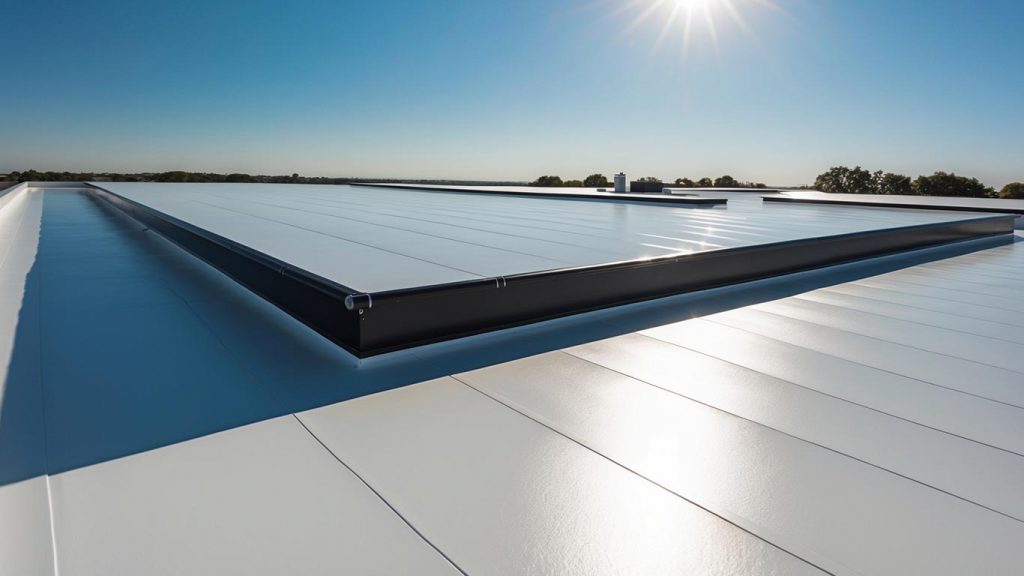
Commercial cool roof systems in Rockwall, TX
Rockwall is a fast-growing commercial hub on the eastern shore of Lake Ray Hubbard. Warehouses, retail centers, and office complexes sit under intense sun with broad roof spans that magnify heat gain. For these properties, high-reflectivity systems deliver measurable comfort and cost control.
SCR, Inc. installs reflective roof coatings, TPO, and PVC solutions for properties along the I-30 corridor and near The Harbor Rockwall. The team utilizes high-solids silicone coatings and reinforced TPO membranes to create a seamless barrier against the Texas sun. These assemblies increase solar reflectance, improve thermal emittance, and work with Polyiso insulation to complete a total building envelope.
Many local buildings deal with thermal shock, UV damage, and ponding water. A reflective, fluid-applied silicone membrane resists UV breakdown and handles standing water better than many alternatives. For structures with exposure to restaurant exhaust or chemicals, PVC membranes from Duro-Last and Carlisle perform well. For retail and office parks in Northshore and Buffalo Creek, the brighter roof surface reduces heat around RTUs, stabilizes indoor comfort, and eases afternoon cooling spikes.
Proudly serving commercial property owners throughout Rockwall 75087 and the surrounding 75032 lakefront communities, SCR, Inc. fields crews with experience around complex penetrations, such as solar panel mounts, large scuppers, and curb flashing for RTUs. The company’s reflective systems reduce the ambient temperature around rooftop AC units, extending the lifespan of your HVAC system and improving customer comfort on peak days.
Why traditional dark roofs fight your comfort goals
Dark, heat-absorbing roofs work against comfort and budget. Black asphalt and EPDM surfaces can absorb close to 90 percent of solar heat, which pushes roof temperatures far above ambient. That heat ages membranes, drives cracks through thermal expansion, and loads your building with unwanted energy. Air conditioners “fight the roof” all afternoon, drawing more power while delivering less relief. High energy bills, early roof degradation, and stressed equipment are the predictable outcomes.
In Rockwall’s urban and suburban zones, this also feeds the Urban Heat Island effect. A cluster of dark roofs raises local air temperature, which in turn raises roof temperature, creating a loop that punishes comfort and AC reliability. A reflective roof helps break that loop at the building level.
The science behind better indoor comfort
Cool roof assemblies improve comfort in four important ways:
- Lower roof skin temperature reduces radiant heat into the deck and attic. Higher thermal emittance releases heat faster after clouds pass or the sun sets. Less attic heat means ducts run cooler and deliver air closer to the setpoint. Reduced rooftop temperature lowers RTU intake air temperature, improving system performance during peak hours.
Add proper insulation and well-sealed penetrations, and the building gains a stable thermal profile. That stability shows up as narrow temperature swings inside, fewer afternoon spikes, and lower indoor humidity.
Local deployment and neighborhoods served
SCR, Inc. is the premier commercial roofing contractor for Rockwall 75032, providing rapid deployment to properties near Lake Ray Hubbard and San Jacinto Plaza. Crews are frequently seen working on commercial projects along the I-30 corridor and near The Harbor Rockwall. From large retail roofs in Northshore to office parks in Buffalo Creek, and residential communities like Shores on Lake Ray Hubbard, Chandlers Landing, Stone Creek, and Breezy Hill, the team provides energy efficient roofing solutions that fit the site. Service areas include Rockwall County and neighboring cities such as Rowlett, Royse City, Forney, Terrell, Wylie, Garland, and Greenville.
Brand options and warranties that stand up to Texas heat
Materials matter for comfort and longevity. SCR, Inc. offers certified installations of GAF and Mule-Hide products to maintain durability and reflectivity across seasons. For superior leak protection and energy savings, the team recommends the Duro-Last “World’s Best Roof” PVC system on appropriate buildings. Carlisle and CertainTeed systems are also available for specific performance goals. For residential steep-slope projects, options from Owens Corning and GAF include cool-color shingle lines that meet Energy Star criteria on select colors and slopes.
These brands provide track records in hot climates, with CRRC-rated surfaces and long-term reflectance retention. As factory-certified installers for Duro-Last and GAF, SCR, Inc. offers NDL (No Dollar Limit) warranties on energy efficient TPO and PVC systems, helping protect commercial investments while improving day-to-day comfort.
Components that make a difference
Detail work around penetrations and edges influences comfort by preventing leaks, air intrusion, and heat traps. Elastomeric coating, silicone membrane, and acrylic coating systems each have a use case based on slope, foot traffic, and ponding risk. Expanded Polystyrene (EPS) or Polyiso board supplies thermal resistance. Scuppers, flashing, seam tape, and primer selection determine long-term stability, especially on parapet edges and RTU curbs. For leak detection and thermal mapping, infrared thermal cameras help locate hidden moisture paths and energy losses. These small factors protect comfort by keeping the envelope consistent and dry.
Roof restoration versus replacement for comfort and cost
If the roof is structurally sound, a reflective coating system can restore performance and improve indoor comfort without a full tear-off. Coatings produce shorter project timelines, less disruption, and a bright surface that cools the building. If the roof has widespread saturation, blistering, or trapped moisture, a replacement with new insulation and a reflective membrane will deliver the best outcome. SCR, Inc. assesses each roof with core samples, moisture scans, and thermal imaging to guide the decision.
For many commercial properties in Rockwall, a roof restoration cuts energy costs 10 to 30 percent compared to a dark surface. The comfort gains show up immediately as cooler aisles and calmer HVAC noise. For homes, a cool roof paired with air sealing and balanced attic ventilation often delivers a noticeable improvement within the first week of summer sun.
Practical signs your building needs a cool roof
- Afternoon hotspots persist even with a low thermostat setting. Second-floor rooms or west-facing spaces feel several degrees warmer. AC runs almost continuously from mid-afternoon to late evening. The roof shows UV cracking, membrane brittleness, or seam degradation. RTUs cycle hard and trip on high head pressure during extreme heat.
These symptoms point to high heat gain and stress at the roof level. A cool roof system addresses the source by reducing solar absorption and improving heat release.
How SCR, Inc. improves comfort for Rockwall properties
SCR, Inc. approaches cool roof projects with a comfort-first mindset. The team starts with a free Thermal Roof Inspection to see exactly where the building is energy efficient roofing losing energy. Infrared visuals show hot seams, damp insulation, or overheated deck sections. energy savings with cool roof systems Former insurance adjusters on staff help document existing damage from hail or wind and align projects with insurers when appropriate. NATE-certified technicians add insight on rooftop AC performance, so the roof and HVAC strategies support each other.
As a member of The Good Contractors List with a $10,000 quality guarantee, and with credentials such as GAF Master Elite, CRRC-rated product options, Energy Star Certified solutions, and BBB accreditation, SCR, Inc. stands behind every cool roof project. The focus stays on measurable comfort, energy reduction, and long-term durability.
The science of reflectivity explained in plain language
Solar reflectance deals with sunlight bounce-back. Thermal emittance deals with how fast the surface sheds heat. A high-reflectance, high-emittance roof stays cooler under the same sun. When paired with continuous insulation such as Polyiso board, the system reduces conductive heat flow into the building. That creates a total building envelope approach where the membrane, insulation, and sealed penetrations work as one.
In practice, this means fewer hot ceilings, calmer AC cycles, and lower peak interior temps. On commercial roofs, the difference often shows up in utility data as a lower afternoon demand spike. On homes, it shows up as comfortable rooms without constant thermostat fiddling.
Energy efficient roofing FAQ
Does a cool roof really lower an AC bill in Rockwall?
Yes, especially during summer. Reflective roofs cut roof surface temperature and reduce heat gain. Many buildings see double-digit reductions in cooling energy use. Actual savings vary with insulation levels, duct condition, and tree cover. For a typical North Texas home or low-slope commercial roof, a 10 to 30 percent cooling energy reduction is a reasonable range.
What is the ROI on a reflective roof coating versus a full replacement?
Coatings deliver a faster payback when the existing roof is sound. Material and labor costs are lower, and the energy savings start immediately. If the roof is saturated or failing, a full replacement with new insulation and a reflective membrane delivers better long-term value and comfort stability. SCR, Inc. provides both options after a thermal and moisture assessment.
Are there local Texas tax credits for energy-efficient commercial roofing?
Programs change. Federal deductions for commercial roofs with added insulation have been available under certain sections of tax code, and utility incentives sometimes apply to reflective surfaces. The SCR, Inc. team tracks current rebates and can coordinate with your accountant or energy consultant to confirm what applies at the time of installation.
Will a cool roof help with the Urban Heat Island effect near The Harbor and I-30?
It helps at the building level and contributes locally. A cluster of reflective roofs reduces ambient air temperature around structures. That supports comfort inside and can ease strain on RTUs in dense commercial zones.
Is metal a good cool roof choice?
Yes, with the right reflective coating system. Standing seam metal with a high-SRI finish can perform very well and pairs nicely with above-deck insulation. It also sheds water efficiently and handles thermal cycling if the clips and details are correct.
Ready for a cooler, quieter building?
For homes and businesses in Rockwall, a cool roof is one of the most direct ways to improve indoor comfort. It reduces peak heat, stabilizes interior temperatures, and helps HVAC equipment breathe. Whether the need is a reflective shingle on a family home in Stone Creek, a TPO system on a retail center in Northshore, or a high-solids silicone restoration for a warehouse near the I-30 corridor, SCR, Inc. has a solution that fits the site and climate.
Request a free infrared thermal inspection and energy audit. See the hot spots, compare options, and get a clear plan. Call SCR, Inc. General Contractors to schedule an on-site assessment in Rockwall 75087 and 75032 or nearby Rowlett, Royse City, Forney, Terrell, Wylie, Garland, and Greenville. A cooler roof means a more comfortable day, fewer afternoon spikes, and an HVAC system that finally gets a break.
SCR, Inc. General Contractors provides roofing, remodeling, and insurance recovery services in Rockwall, TX. As a family-owned company, we handle wind and hail restoration, residential and commercial roofing, and complete construction projects. Since 1998, our team has helped thousands of property owners recover from storm damage and rebuild with reliable quality. Our background in insurance claims gives clients accurate estimates and clear communication throughout the process. Contact SCR for a free inspection or quote today.
SCR, Inc. General Contractors
440 Silver Spur Trail
Rockwall,
TX
75032,
USA
Phone: (972) 839-6834
Website: https://scr247.com/, Storm damage roof repair
Map: View on Google Maps
Social Media: Yahoo Local